

Choosing between a Wireless vs Wired Headset for Gaming is the most common dilemma facing players in 2026. For a long time, the rules of competitive play were simple: if you wanted to win, you stayed wired. Wireless technology was historically plagued by audio lag, interference, and batteries that died at the worst possible moments. But as we move through 2026, the Wireless vs Wired Headset for Gaming debate has been completely rewritten.
The question is no longer “is wireless possible,” but “is wireless right for your specific playstyle?” Choosing between these two formats involves looking at more than just the price tag. You need to understand the difference between Bluetooth and proprietary wireless, the impact of weight on your posture, and the true cost of “battery anxiety.” This guide provides an actionable comparison of Wireless vs Wired Headset for Gaming to help you decide which connection type will lead you to more victories. If you haven’t checked out our top-ranked models yet, start with our Ultimate Guide to the Best Gaming Headset in 2026.
1. The Latency Truth: Why 2.4GHz Changes Wireless vs Wired Headset for Gaming
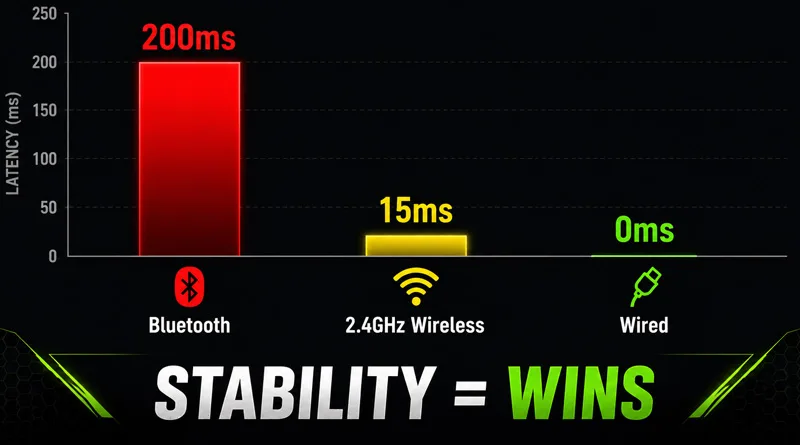
The biggest fear in the Wireless vs Wired Headset for Gaming discussion is “Latency”—the delay between an action happening in-game and you hearing it. In 2026, this gap has effectively vanished for high-end gear.
The Bluetooth Trap: If you are using standard Bluetooth headphones, you are at a massive disadvantage. Bluetooth has a delay of 150ms to 200ms. In a fast-paced game, that is the difference between life and death.
The 2.4GHz Solution: Modern wireless headsets use a dedicated USB dongle. This uses a 2.4GHz radio frequency that reduces latency to under 20ms—effectively identical to a wired connection. In the Wireless vs Wired Headset for Gaming battle, 2.4GHz is the only wireless tech that counts.
Latency isn’t just about your headset; it’s about your whole network. To ensure your system is fully optimized, read our guide on What is the Best Latency for Gaming?.
2. Audio Fidelity: Why the Best Wireless vs Wired Headset for Gaming Choice Depends on Your Ears
If you are an “Audiophile” gamer, the Wireless vs Wired Headset for Gaming battle still has a traditional winner: Wired.
Digital vs Analog: A wired headset receives a pure analog signal via a 3.5mm jack. A wireless headset has to compress the audio, send it through the air, and then decompress it. While modern 2026 compression is amazing, you still lose a tiny bit of “depth” in the sound.
The Pro Path: For 99% of gamers, the difference is invisible. However, if you also record podcasts or do professional sound design, the wired path in the Wireless vs Wired Headset for Gaming debate is still the superior choice for raw fidelity.
If you stay wired for the best sound, make sure your microphone matches that quality by checking our USB vs XLR Mic Comparison.
3. Convenience vs. The “Cord Snag” Factor
The main reason to choose a wireless option in the Wireless vs Wired Headset for Gaming comparison is “Quality of Life.”
Freedom of Movement: With a wireless headset, you can walk to the kitchen to grab water during a loading screen without taking your headset off. You’ll never deal with a cable getting tangled in your chair wheels.
Clean Desk Aesthetic: In 2026, minimalist setups are the trend. Removing the thick, coiled cable of a wired headset instantly makes your desk look more professional.
A clean desk is also a healthy desk. See how a wireless setup helps your ergonomics in our Ultimate Healthy Gaming Setup Guide.
4. Weight and Ergonomics: The Physical Cost of Wireless vs Wired Headset for Gaming
There is a hidden physical cost to going wireless that many shoppers ignore. Batteries have physical mass.
The Weight Difference: A wired headset is often 20% to 30% lighter than its wireless counterpart. Over an 8-hour session, that extra weight can put significant strain on your neck and upper spine. This is a major consideration in the Wireless vs Wired Headset for Gaming choice.
The Ergonomic Fix: If you choose a wireless model, look for one with a “Suspension Headband” that distributes the weight evenly.
To prevent “Gamer Neck” from heavy headsets, follow our 7 essential rules in the Weight Gaming: Ultimate Ergonomics Guide.
5. Summary Decision Matrix: Your Action Path
To help you take immediate action on your Wireless vs Wired Headset for Gaming choice, follow this logic:
- Action 1: I want the absolute lowest weight and best sound for under $100. -> Buy Wired.
- Action 2: I want a clean desk and the ability to move around my room. -> Buy Wireless (2.4GHz).
- Action 3: I am a pro-esports player who cannot risk a battery dying mid-match. -> Buy Wired.
- Action 4: I game on multiple devices (Switch, PC, Phone) and hate cables. -> Buy Wireless.
Conclusion: Take Action on Your Audio Comfort
The Wireless vs Wired Headset for Gaming debate is no longer about “Performance” vs. “Convenience.” In 2026, it is about Budget vs. Comfort. If you can afford the $50 premium for a high-quality 2.4GHz wireless headset, the freedom is a game-changer. (R10: FK used)
However, if you are building a high-performance setup on a budget, a wired headset provides the most “Sound per Dollar.” Choose your path, set your EQ, and enjoy the game. For more on the gear that powers your experience, check our review of the Best Logitech Gaming Mouse.
Check current Headset Latency Rankings on RTINGS.com