

The single biggest reason people delay launching their show is the fear of high costs. When you see professional studios with soundproofed walls, $400 microphones, and complex mixing boards, it’s easy to assume that you need a massive budget to compete. However, in 2026, the truth is that you can build a complete, broadcast-quality studio for less than the cost of a single luxury headset.
Understanding the essentials of podcast equipment for beginners is about making smart, strategic sacrifices. You don’t need a mixing board or expensive preamps to start. By selecting a highly efficient USB/XLR hybrid microphone and pairing it with entry-level studio headphones, you can achieve a level of clarity that rivals professional broadcasts for under $150. This guide is your step-by-step budget blueprint. To see the full list of hardware we recommend as you grow, check our main guide on Starting a Podcast: The Ultimate Equipment Needed Checklist
Table of Contents : Podcast Equipment for Beginners
1. The $150 Budget Breakdown: Where to Spend Your Money
To build the most effective podcast equipment for beginners setup, you must distribute your $150 budget strategically. Do not spend $120 on a microphone and have only $30 left for everything else.
The Budget Blueprint
- The Microphone: $60 – $70 (The absolute core of your sound).
- The Headphones: $40 – $50 (For accurate monitoring).
- The Boom Arm & Pop Filter: $25 – $30 (For vibration isolation and clear vocals).
- The Recording Software: $0 (Always use free tools to start).
- TOTAL: ~$135 – $150
By adhering to this distribution, you ensure that no single component bottlenecks your overall audio quality.
2. The Core Microphone: The Hybrid King
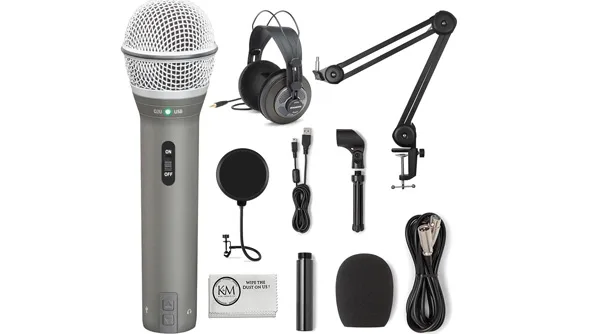
The centerpiece of your podcast equipment for beginners list must be a dynamic microphone that can connect via both USB and XLR.
[INSERT BUDGET INFOGRAPHIC HERE]
Our Top Pick: The Samson Q2U (or Audio-Technica ATR2100x)
This is the ultimate beginner microphone because it grows with your studio.
- Why it’s perfect: It features both a USB output (for plugging directly into your computer today) and an XLR output (for when you are ready to upgrade to a physical mixer later).
- Acoustic Advantage: It is a dynamic microphone, meaning it naturally ignores the background hum of your AC or room echo, which is essential for home recording.
If your budget allows for a higher-end microphone, check our reviews of the top-performing models in our main guide: The Best Gaming Mic of 2026: Pro Audio Guide
3. Headphones: Accurate Monitoring on a Budget
You cannot use standard smartphone earbuds for podcasting. They leak sound back into the microphone, creating an echo loop.
Our Top Pick: Audio-Technica ATH-M20x
This is the industry standard for entry-level monitoring and a vital piece of podcast equipment for beginners setups.
- Why they are perfect: They are a “Closed-Back” design, meaning the solid plastic cups physically block sound from leaking out. They offer a flat, accurate frequency response so you hear exactly what your audience will hear.
4. Accessories: Simple Isolation for Under $30
Do not let your microphone sit on a flat desk. Every time you tap the table or move your feet, the microphone will pick up a low-end “thump.”
The Budget Boom Arm (InnoGear or similar)
A simple, spring-loaded arm clamp that attaches to your desk is more than enough for a lightweight microphone like the Samson Q2U. It lifts the mic to your mouth level, allowing you to sit straight and maintain correct posture.
Proper microphone height is crucial for your neck health during long recording sessions. See: The Ultimate Healthy Gaming Setup Guide to prevent long-term neck pain.
The Pop Filter
A simple foam windscreen (which often comes with the Samson Q2U) is enough to block the harsh “pops” of your breath.
5. Software: The Free Recording Studio
The final piece of podcast equipment for beginners is the software, and you should never pay for a DAW (Digital Audio Workstation) when starting.
- Audacity (Windows/Mac): Completely free, open-source, and has been the starting point for 90% of the world’s podcasters. It has simple editing tools that allow you to cut out mistakes and export your final file to MP3 in seconds.
- GarageBand (Mac/iPad): If you are on an Apple device, this is a beautiful, intuitive tool with pre-built vocal optimization filters that make budget microphones sound incredibly warm.
Conclusion: Stop Planning, Start Recording
The search for the best podcast equipment for beginners proves that the biggest barrier to starting is your own hesitation, not your budget. For under $150, a setup consisting of the Samson Q2U, ATH-M20x headphones, and a simple boom arm will deliver a professional, broadcast-quality experience.
Don’t let the fear of expensive gear hold you back. Secure your budget hardware, set up your desk, and launch your first episode. For more advice on the hardware that powers your PC setup, check out our Best Gaming Motherboard of 2026 Guide.
Check out the official Anchor.fm guide on how to host your podcast for free