

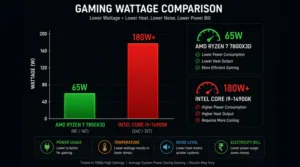
For pure gaming performance and long-term platform value in 2026, AMD is the overall winner of the amd vs intel gaming battle. AMD’s 3D V-Cache processors (like the Ryzen 7 7800X3D and 9800X3D) deliver the highest frame rates in modern titles while drawing nearly half the electrical power of Intel’s top chips. More importantly, AMD has officially committed to supporting the AM5 motherboard socket until 2027+, meaning you can upgrade your CPU in three years without buying a new motherboard or RAM. Intel remains superior primarily for heavy workstation productivity and video editing.
For over two decades, the processor market was dominated by Intel’s clock-speed supremacy. However, the dynamics of amd vs intel gaming have fundamentally shifted. Between Intel’s frequent motherboard socket retirements and AMD’s breakthrough cache architecture, choosing your processor brand dictates your upgrade path for the next five years. This guide breaks down gaming benchmarks, electrical efficiency, socket longevity, and total build costs to help you choose the right CPU for your rig. To choose the right foundation for either brand, check our master guide on The Best Gaming Motherboard of 2026.
Table of Contents
1. Gaming Performance: The 3D V-Cache Advantage
When evaluating amd vs intel gaming in competitive and AAA titles, AMD’s secret weapon is 3D V-Cache (X3D) technology.
Why Cache Matters More Than Clock Speed
Traditionally, Intel won gaming benchmarks by pushing raw clock speeds past 5.5GHz. However, modern game engines are heavily limited by how fast the CPU can access data from memory.
- AMD’s Solution: By physically stacking a massive 64MB slice of L3 cache directly on top of the processor die, AMD’s X3D chips allow the CPU to store critical game data instantly next to the cores.
- The Gaming Result: In titles like Valorant, Counter-Strike 2, World of Warcraft, and Microsoft Flight Simulator, AMD X3D chips deliver significantly higher average frame rates and smoother 1% low frame times than Intel chips running at higher clock speeds.
2. Platform Longevity: AM5 (2027+) vs. Intel LGA Sockets
The most decisive factor in the amd vs intel gaming debate on Reddit and hardware forums is Motherboard Socket Longevity.
The AMD AM5 Commitment (Supported Until 2027+)
AMD introduced the AM5 socket with Ryzen 7000 and has publicly confirmed support through at least 2027.
- The Upgrade Advantage: If you buy an affordable B650 or B650E motherboard today, you will be able to buy a brand-new, next-generation Ryzen CPU in 2027 and drop it straight into your existing board with a simple, free BIOS update.
Explore the best AM5 boards in our dedicated comparison: AMD B650 vs B650E: Which Motherboard Chipset is Best for Gaming?
Intel’s Platform Lifecycles
Intel notoriously designs its platforms to last only two CPU generations before introducing a new physical socket.
- The Upgrade Penalty: The LGA 1700 platform (12th, 13th, and 14th Gen) is now officially retired. Upgrading to Intel’s newest desktop generation (LGA 1851) requires purchasing a brand-new motherboard and potentially new cooling brackets, significantly increasing your long-term ownership costs in the amd vs intel gaming equation.
3. Power Draw, Heat, and Cooling Requirements
Electricity consumption directly impacts your room’s ambient temperature and your cooling budget.
AMD: Peak Efficiency
Because of advanced manufacturing nodes and architectural design, AMD Ryzen processors draw remarkably little power during gaming workloads.
- Gaming Draw: A Ryzen 7 7800X3D draws between 50W and 85W during heavy gaming. It can be kept ice-cold with an affordable $35 dual-tower air cooler.
See why you don’t need expensive liquid cooling for AMD: Peerless Assassin vs Phantom Spirit: Which Cooler Wins?
Intel: The High-Wattage Trade-Off
Intel’s high-end processors (like the Core i7-14700K and i9-14900K) achieve their performance by drawing massive amounts of power.
- Gaming Draw: High-end Intel chips frequently draw 140W to 220W+ during games, generating intense heat that practically demands a 240mm or 360mm AIO liquid cooler.
Wondering if an i5 is easier to cool than an i7? Read: Intel i5 vs i7 for Gaming: Is the Extra $100 Worth It?
4. Where Intel Still Wins: Productivity and Budget Mid-Range
While AMD leads in pure gaming, Intel retains distinct advantages in specific computing scenarios.
1. Video Editing and Content Creation
Intel’s hybrid architecture pairs large Performance cores (P-cores) with numerous smaller Efficiency cores (E-cores). For rendering video in Adobe Premiere, 3D modeling in Blender, or heavy code compilation, Intel processors often beat price-equivalent AMD chips.
2. Intel QuickSync Video
Intel processors with integrated graphics feature QuickSync, a dedicated hardware video encoder. For streamers using a single-PC setup, QuickSync allows OBS to encode your live stream with virtually zero impact on your in-game frame rate.
Curious about Intel’s best value gaming chip? See our full review: Is Intel Core i5 Good for Gaming in 2026?
5. Summary Decision Matrix: AMD vs Intel Gaming
Use this checklist to choose your ideal processor in the amd vs intel gaming lineup:
Choose AMD (AM5 Platform) if:
- Your primary activity is competitive FPS gaming, simulation titles, or open-world AAA games.
- You want to keep your motherboard for 3 to 4 years and upgrade your CPU later.
- You want lower electricity bills and quiet, low-temperature air cooling.
- Top Recommendations: AMD Ryzen 7 7800X3D (Best Gaming CPU) or AMD Ryzen 5 7600X (Best Budget Gaming CPU).
Choose Intel if:
- You use your PC equally for heavy 4K video editing, CAD design, or virtual machines alongside gaming.
- You are building a budget system using an affordable 12th or 13th Gen Core i5 with existing DDR4 memory.
- Top Recommendations: Intel Core i5-13400F (Best Budget Value) or Intel Core i7-14700K (Best Productivity Hybrid).
Conclusion: AMD Takes the 2026 Gaming Crown
In the final evaluation of amd vs intel gaming, AMD has earned its status as the default recommendation for PC gamers. With unbeatable gaming frame rates from 3D V-Cache, low power draw, and a guaranteed motherboard upgrade path through 2027+, the AM5 ecosystem offers the best performance and investment protection on the market.
Unless your daily routine revolves around heavy workstation rendering, investing in an AMD AM5 setup is the smartest move you can make for your gaming setup.
Check out independent CPU gaming hierarchy benchmarks on Tom’s Hardware