

In the world of competitive gaming, your reaction time is only half of the equation. The other half is the speed at which your data travels to the server and back. As we dive into the 2026 gaming season, the debate over Fiber vs Cable for Gaming Latency has reached a fever pitch. While both can offer “fast” speeds, the physics behind how they transmit data are fundamentally different, leading to massive discrepancies in your final ping and jitter.
Understanding the technical nuances of Fiber vs Cable for Gaming Latency is essential for any player looking to reach the top ranks of Valorant, Counter-Strike, or League of Legends. In this guide, we will break down why light-based transmission beats electrical pulses, the impact of neighborhood congestion, and how to optimize your current setup regardless of which technology you use. If you haven’t yet chosen a provider, start with our master guide on the Best Internet Providers for Gaming.
1. The Physics of Speed: How Fiber vs Cable for Gaming Latency Differs
To understand the winner of the Fiber vs Cable for Gaming Latency battle, we have to look at the physical medium of the connection.
Fiber Optics: The Speed of Light
Fiber optic internet uses thin strands of glass or plastic to transmit data as pulses of light. Because light travels incredibly fast and experiences very little resistance through glass, the data remains “pure” over long distances.
- Latency Impact: This results in near-instant communication. Fiber users typically see pings between 1ms and 15ms.
Cable Internet: Electrical Pulses
Cable (Coaxial) internet uses copper wires to transmit data via electrical signals. While copper is a good conductor, it is subject to electromagnetic interference and signal degradation over long distances.
- Latency Impact: Electricity through copper is inherently slower than light through glass. Cable users usually experience pings between 20ms and 60ms—still playable, but objectively slower in the Fiber vs Cable for Gaming Latency comparison.
2. Jitter and Consistency: The Hidden Performance Killer
In 2026, professional gamers aren’t just looking at the average ping; they are looking at Jitter. Jitter is the variance in your latency over time. This is where the Fiber vs Cable for Gaming Latency gap becomes most apparent.
The Problem with Shared Copper Loops
Cable internet is a “shared medium.” Your connection runs on a loop that also serves your neighbors. During peak hours (evenings and weekends), the electrical noise on that copper line increases as more people use it.
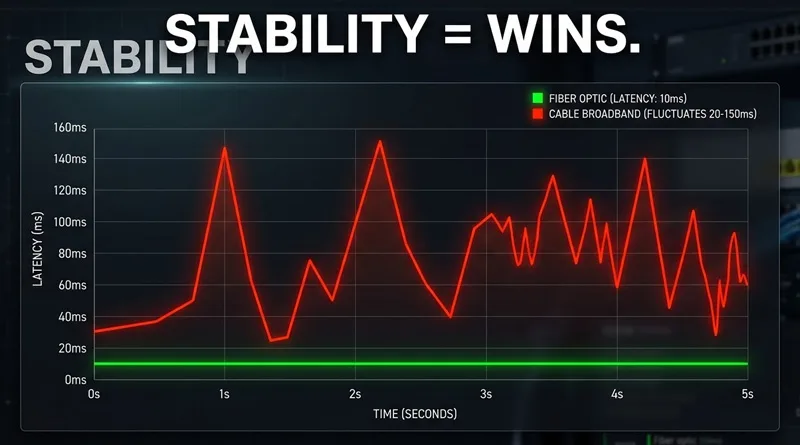
- The Result: Your ping might be 20ms one second and spike to 120ms the next. This “ping spike” or jitter causes your character to “rubber-band” or glitch, even if your average speed is high.
Fiber’s Dedicated Path
Fiber connections are often “Fiber to the Home” (FTTH), meaning you have a dedicated strand of light coming into your house. It is immune to the electromagnetic interference that plagues copper. When analyzing Fiber vs Cable for Gaming Latency, Fiber provides a rock-solid, flat line of latency that never fluctuates.
Knowing your target is vital. See our deep-dive on What is the Best Latency for Gaming to see where your connection stands.
3. Symmetrical Speeds: Why Upload Matters for Fiber vs Cable for Gaming Latency
A common misconception is that download speed is all that matters. However, for gaming, your Upload Speed is just as critical because it carries your “inputs” (mouse clicks, movement, voice chat) to the server.
- Cable (Asymmetric): Most cable plans offer high download but very low upload (e.g., 500 Mbps down / 20 Mbps up). If you are streaming or using Discord, you can easily saturate that 20 Mbps upload, causing a “bufferbloat” bottleneck that spikes your latency.
- Fiber (Symmetric): Fiber almost always offers identical speeds both ways (e.g., 500 Mbps down / 500 Mbps up). This massive upload overhead ensures your game packets never have to wait in line.
The ability to send data as fast as you receive it is a primary reason why Fiber vs Cable for Gaming Latency is a one-sided fight in favor of Fiber.
Is your upload bottlenecking your FPS? Find out in our guide: Does Upload Speed Affect Gaming.
4. Optimizing Your Hardware for the Best Latency
Whether you are on the winning side of the Fiber vs Cable for Gaming Latency debate or stuck with a copper connection, your internal hardware acts as the final gatekeeper for your ping.
The Modem/ONT Factor
Fiber users use an ONT (Optical Network Terminal), while Cable users use a Modem. In 2026, ensure your cable modem is DOCSIS 3.1 or higher. Older DOCSIS 3.0 modems have terrible latency management and will lose every Fiber vs Cable for Gaming Latency test.
The Gaming Router Solution
A high-end router is the only way to manage the traffic in a busy household. If someone is streaming 4K video while you are gaming, a standard router will prioritize the video, causing you to lag.
- The Fix: Use a router with advanced Quality of Service (QoS) to keep your game packets at the front of the queue.
We have reviewed the best models to handle these high-speed connections. Read: The Best Gaming Router of 2026.
Conclusion: Which Technology Wins for Gaming?
After analyzing the physics, the congestion patterns, and the upload stability, the winner of Fiber vs Cable for Gaming Latency is clear: Fiber Optic is the superior technology for competitive play.
If Fiber is available at your address, it is the single most effective upgrade you can make to your gaming performance—more impactful than a new GPU or mouse. However, if you are limited to Cable, focusing on high-quality hardware like DOCSIS 3.1 modems and Cat6 Ethernet cables can help bridge the gap.
Check if Fiber is available in your Zip Code via BroadbandNow