

Finding the Best Internet for Gaming in Rural Areas used to be a hopeless task. For decades, players in remote locations were trapped with sluggish DSL or traditional satellite connections that made competitive play impossible due to 600ms+ ping. However, as we move into 2026, the landscape has shifted. New technologies like Low Earth Orbit (LEO) satellites and wide-reaching 5G networks have finally made it possible to find the Best Internet for Gaming in Rural Areas without having to move to the city.
In this guide, we break down the top technologies currently available for remote players. We will compare Starlink, 5G Home Internet, and Fixed Wireless providers to help you determine which one offers the lowest latency and most stable connection for your rig. Before you commit to a contract, it’s important to understand how these technologies stack up against standard city connections. If you want to see how these compare to urban options, check out our main guide on the Best Internet Providers for Gaming.
1. Why Finding the Best Internet for Gaming in Rural Areas is Challenging
The primary enemy of the rural gamer is not speed—it is Latency (Ping). You can have a “fast” connection that is still unplayable for gaming if the data takes too long to travel to the server.
The Distance Bottleneck
Most game servers are located in major data hubs (like Virginia, Chicago, or San Francisco). In rural areas, your data must travel through several “hops” or bounce off a satellite before reaching these hubs. This physical distance adds milliseconds to your ping.
Infrastructure Limitations
Fiber optic cables are expensive to lay. Because there are fewer houses per mile in the countryside, ISPs often refuse to build the infrastructure, leaving users with old copper phone lines (DSL) or cable lines that are prone to congestion. To find the Best Internet for Gaming in Rural Areas, you must look beyond traditional wires.
2. Low Earth Orbit (LEO) Satellite: The Starlink Revolution
For many, Starlink is the definitive Best Internet for Gaming in Rural Areas. Unlike traditional satellite internet (like HughesNet or Viasat), Starlink uses a constellation of thousands of small satellites that orbit much closer to Earth.
The Latency Advantage
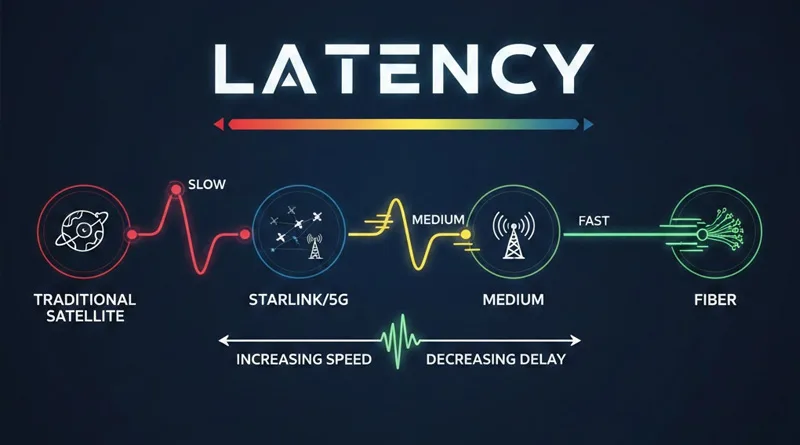
Traditional satellites orbit at 22,000 miles, creating a 600ms delay. Starlink orbits at roughly 340 miles. This reduction in distance allows for ping times between 30ms and 60ms, which is perfectly acceptable for FPS games like Valorant or Call of Duty.
Reliability in 2026
With more satellites launched every month, the “mini-disconnects” that plagued Starlink early on are becoming rare. It remains the most viable, widespread solution for the Best Internet for Gaming in Rural Areas where no towers or wires exist.
3. 5G Home Internet: The Cellular Contender
If you have a strong cell signal at your house, 5G Home Internet (from T-Mobile or Verizon) is a strong candidate for the Best Internet for Gaming in Rural Areas.
How it Works
The ISP sends you a gateway (a specialized 5G router) that picks up the 5G signal from a nearby tower and broadcasts it as Wi-Fi in your home.
The Pros and Cons for Gamers
- Pros: Very low monthly cost, no equipment fees, and surprisingly fast download speeds.
- Cons: Higher Jitter than wired connections. Because cellular networks are “shared” with mobile phones, your ping can spike during peak hours when the tower is busy.
To ensure your 5G connection stays stable, your internal hardware needs to be top-tier. A dedicated network manager is essential to prioritize your game data. See our reviews of the hardware that can help: The Best Gaming Router of 2026.
4. Fixed Wireless: The Regional Secret
Many rural residents overlook WISPs (Wireless Internet Service Providers). These are small, local companies that install a radio dish on your roof that points directly to a nearby tower.
Why WISPs are Hidden Gems
If you are within “Line of Sight” of a tower, Fixed Wireless can provide a connection that rivals cable internet. Because the signal doesn’t travel into space, the latency is often very low (20ms – 40ms). When looking for the Best Internet for Gaming in Rural Areas, always check for local WISPs before signing up for a national brand.
5. Optimizing Your Best Internet for Gaming in Rural Areas
No matter which technology you choose, a rural connection requires more maintenance than a city fiber line. Use these three rules to keep your ping low.
Rule 1: Always Use a Shielded Ethernet Cable
Wi-Fi interference is the last thing you need on a rural connection. Using a wired path is the only way to ensure the “raw” latency of your ISP is what you actually experience in-game.
Don’t let your cable be the bottleneck. Learn which categories provide the most stability: Best Ethernet Cable for Gaming.
Rule 2: Prioritize Your Traffic (QoS)
Rural connections (especially 5G and Satellite) have limited upload bandwidth. If someone else in the house starts a video call, your game will lag instantly. You must use a router with Quality of Service (QoS) to keep your game packets at the front of the line.
Rule 3: Monitor Your Latency Benchmarks
Understand that your connection will fluctuate. Knowing what a “good” number looks like for your specific tech is vital.
Set your expectations by reading: What is the Best Latency for Gaming.
Conclusion: Which is the Best Internet for Gaming in Rural Areas?
The final verdict depends on your specific location:
- If money is no object: Starlink is the overall Best Internet for Gaming in Rural Areas due to its global availability and improving latency.
- If you are near a cell tower: 5G Home Internet offers the best value and decent performance for casual and competitive players.
- If you have Line-of-Sight to a tower: A local Fixed Wireless (WISP) provider is often the secret to the lowest possible ping.
Regardless of your choice, the key to success is moving away from old DSL and traditional high-orbit satellite. Relish the freedom of the countryside without the penalty of lag by choosing a modern, low-latency provider.