

If you have watched a major Valorant, Apex Legends, or Counter-Strike 2 tournament recently, you may have noticed a striking visual trend: professional players are no longer wearing traditional over-ear headsets to hear the game. Instead, they are wearing small, transparent earpieces tucked directly into their ears. The movement toward in ear monitors for gaming (commonly known as IEMs) has officially moved from a niche audiophile secret into a mainstream competitive standard in 2026.
While over-ear headsets offer convenience, they carry physical drawbacks like heavy clamping force, ear sweat, and muddy bass that obscures delicate sound cues. This guide breaks down why choosing in ear monitors for gaming offers superior positional awareness, explains the unique multi-driver technology inside these compact shells, and reviews the best budget-to-pro models available today. To see how IEMs fit into our broader display and audio rankings, explore our master guide on the 5 Best Gaming Earbuds in 2026.
1. Why Esports Pros Choose In Ear Monitors for Gaming
The shift toward IEMs is driven by physical ergonomics and acoustic precision rather than fashion.
Superior Footstep Clarity and Flat EQ
Standard gaming headsets are famous for “bloated bass”—heavy low-end frequencies designed to make explosions sound dramatic. Unfortunately, loud bass drowns out high-frequency sounds like enemy footsteps, weapon reloads, and scope zooms.
- The IEM Difference: The best in ear monitors for gaming feature a much flatter, more technical frequency response. They separate audio channels clearly, allowing you to pinpoint the exact direction of a footstep through a wall without it being muffled by a grenade blast.
Zero Headband Pressure and Heat
Heavy headsets apply constant clamping force to your skull and cause ear sweat during long tournaments.
- Ergonomics Advantage: IEMs weigh only a few grams and rest entirely inside your ear canal. They eliminate “headset dent,” reduce neck strain, and keep your head cool during marathon grinding sessions.
Physical comfort directly impacts your focus. Learn how earphone weight connects to overall posture in Weight Gaming: The Ultimate Ergonomics Guide.
2. Driver Technology: How IEMs Pack Studio Sound into Tiny Shells
The secret behind the performance of in ear monitors for gaming is how their internal drivers are engineered.
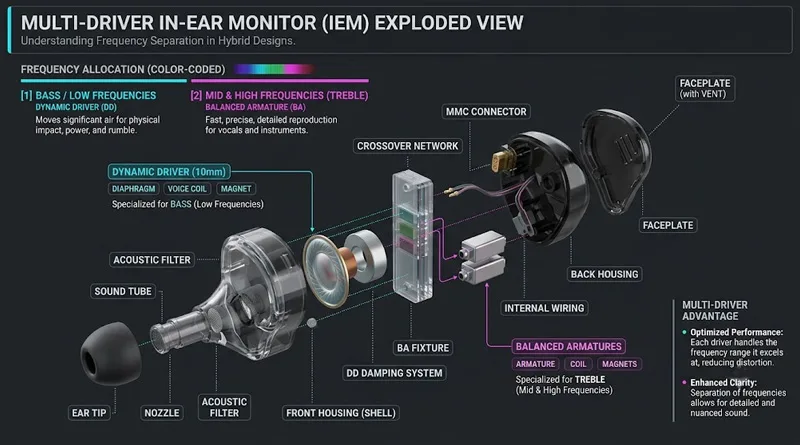
Dynamic Drivers (For Bass and Power)
Traditional earbuds use a single dynamic driver (a small speaker cone). While good for general music, a single driver can struggle when handling heavy bass and delicate high-pitched footsteps at the exact same time.
Balanced Armature (BA) Drivers (For High-Frequency Precision)
Higher-end IEMs use tiny “Balanced Armature” drivers originally developed for hearing aids. They move almost zero air but produce ultra-fast, pinpoint-accurate high frequencies.
Hybrid Configurations
The best in ear monitors for gaming combine both: a Dynamic Driver for rich environment sounds and 1-4 Balanced Armatures dedicated purely to crisp treble and positional cues.
3. Top 4 Best In Ear Monitors for Gaming in 2026
You do not need to spend hundreds of dollars to experience the benefits of IEMs. The budget IEM market offers incredible performance for under $50.
1. The Undisputed Budget King: KZ ZS10 Pro (or ZS10 Pro X)
This is the gateway model for 90% of gamers making the switch. It features a hybrid 5-driver setup (1 Dynamic + 4 Balanced Armatures) inside a durable stainless-steel and resin housing.
- Why It Wins: It provides incredible instrumental separation, allowing you to hear subtle positional audio cues that $150 gaming headsets miss completely.
2. The Ultra-Budget Entry: Tangzu Wan’er / 7Hz Salnotes Zero
If you have a strict $20 budget, these single-dynamic-driver IEMs are a revelation. They offer a clean, neutral sound signature that outperforms almost every budget gaming headset on the market.
3. The Competitive Sweet Spot: Truthear x Crinacle Zero:RED
Tuned specifically by renowned audio reviewer Crinacle, the Zero:RED uses a dual-dynamic driver configuration (including a dedicated subwoofer).
- Why It Wins: Excellent sub-bass extension combined with clean, smooth highs that make directional audio in FPS games feel almost like cheating.
4. The Pro Audiophile Choice: Sennheiser IE 200
For players who want a sleek, ultra-comfortable IEM from a legacy audio brand. The IE 200 features Sennheiser’s TrueResponse 7mm dynamic driver, providing a remarkably wide soundstage.
4. Setup and Accessories: Getting the Best Performance
To get the most out of your in ear monitors for gaming, a few simple setup steps make a massive difference.
The $10 DAC Upgrade (Digital-to-Analog Converter)
Most motherboard onboard audio jacks suffer from electrical noise (humming/hissing). Because IEMs are extremely sensitive, you will hear this background hiss.
- The Action Fix: Buy a cheap USB-C to 3.5mm DAC dongle (like the official Apple USB-C Dongle or a CX31993 DAC). This provides a completely clean, hiss-free signal to your IEMs for
10−10−15.
Standalone Microphone Integration
Since IEMs do not have built-in boom microphones, you need a separate microphone solution.
- Option A: Use a dedicated USB/XLR desk microphone.
- Option B: Buy an aftermarket IEM cable that has an in-line microphone attached directly to the wire.
Pair your new IEMs with a broadcast-quality desk mic. See our picks in 7 Best Gaming Mic Options in 2026.
Conclusion: Upgrade Your Positional Audio Today
Making the switch to in ear monitors for gaming is one of the most cost-effective performance upgrades available. For less than $50, an IEM like the KZ ZS10 Pro delivers a level of directional audio clarity and physical comfort that heavy over-ear headsets simply cannot match.
Say goodbye to headset dents, sweaty ears, and muddy bass. Grab a pair of IEMs, plug them into a simple DAC, and experience your favorite competitive games with newfound clarity.
Check detailed IEM frequency response measurements on Squig.link